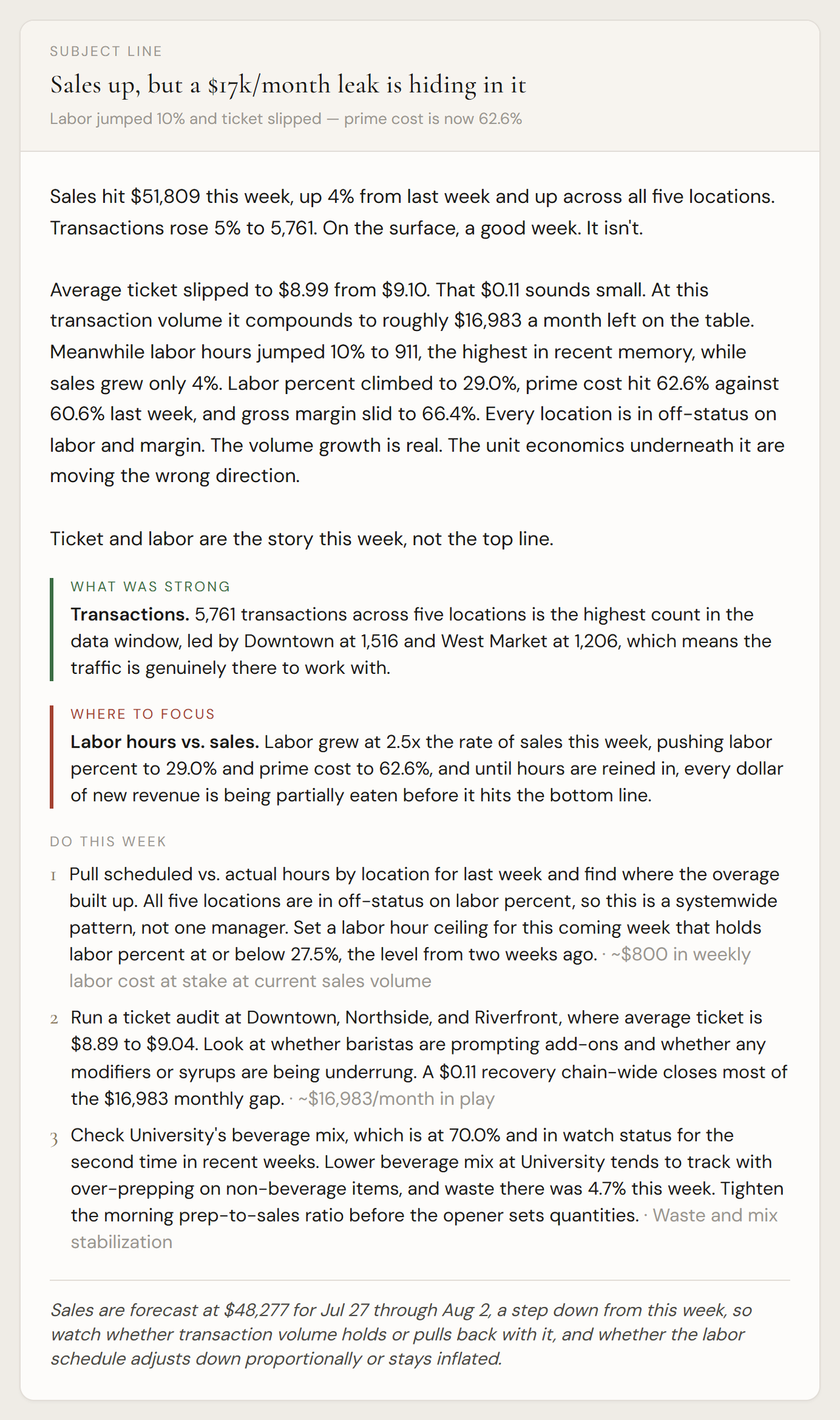
Most business leaders don’t. Not because the information doesn’t exist, but because no one has translated it into something clear, specific, and ready when Monday begins.
Your data exists. Your clarity doesn’t.
Information arrives too late, from too many places, in a format that requires interpretation before it’s useful. By the time you’ve assembled a picture of last week, the week is already over. Leadership meetings start with questions when they should start with decisions.
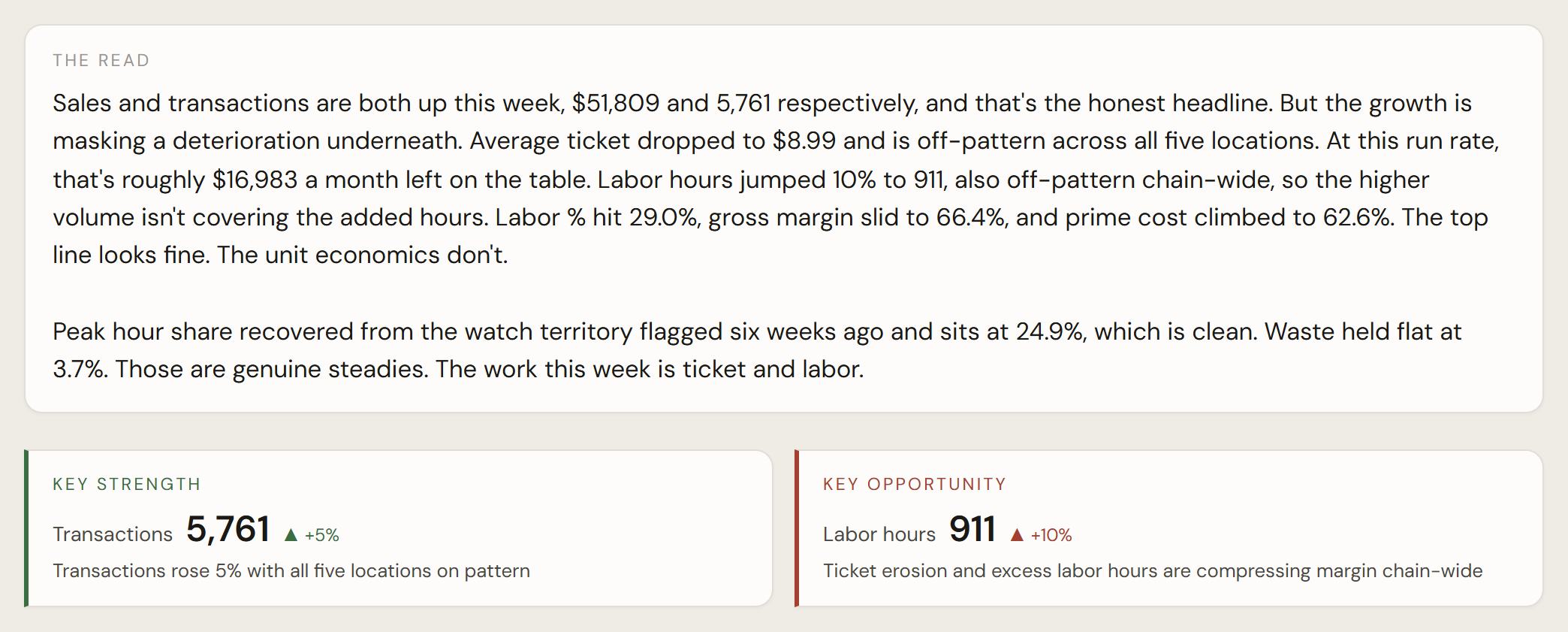
Performance Pulse is a weekly brief and a place to explore the why behind it. The brief tells you what matters this week: the five-minute Monday read. When a number raises a question, you can explore it: what drove it, whether it’s a trend, how you’re tracking, and what happens if you act.
Layer one: the brief that lands Monday morning.
Generic tools are powerful, but they start from zero every time. You configure the blank slate, then you’re left to interpret it yourself. Performance Pulse starts from your business: your metrics, your goals, your operational context. That foundation is what makes the interpretation feel like it was written by someone who knows your business, rather than applied to it.
It also changes the order. Most tools give you the data and leave you to interpret it. Performance Pulse gives you the interpretation first. The brief tells you what matters, and when a number raises a question, you explore the why. Both run on the same foundation, so the Monday read and what you find when you dig in tell the same story.
That sequencing is a deliberate choice. It reflects a belief: the thing a leader needs on Monday morning isn’t more data. It’s a clear, grounded read on what actually happened, and a sense of where to focus next.
Before your first brief, we establish exactly what your key metrics mean. What counts, what doesn’t, and how each one maps to how your business actually runs. That precision is what makes both layers accurate rather than approximate: the weekly read, and anything you explore beneath it.
Every metric has a threshold that matters to your business specifically. Performance Pulse measures against your goals, not industry averages, not generic benchmarks. So whether a number surfaces in the brief or you go looking for it yourself, it’s judged on your targets. Your signal.
The longer Performance Pulse runs inside your business, the more it reflects what’s actually normal for you. Patterns get clearer and anomalies get easier to spot. Both the weekly read and what you can dig into are sharper at month twelve than they were at week four.
Most tools give you the same experience on day one as day three hundred. Performance Pulse is different. Every week it runs inside your business, the intelligence becomes more accurate, more specific, and more useful. Here’s what that looks like in practice.
Enough data to establish what normal looks like for your business. The first real Pulse narratives. You begin trusting the brief.
One quarter of history. Seasonal tendencies begin to surface. The brief starts catching things you hadn’t consciously registered yet.
Six months. The system knows what’s normal for your operation. A drop that would have looked alarming in week four is now understood in context. You stop second-guessing it.
One full year. Seasonality is encoded, year-over-year comparisons are real, and the brief has a track record your leadership team has built its Monday around.
By week 52, the brief knows your business the way a long-tenured analyst would. That context is yours. It compounds every week you run.
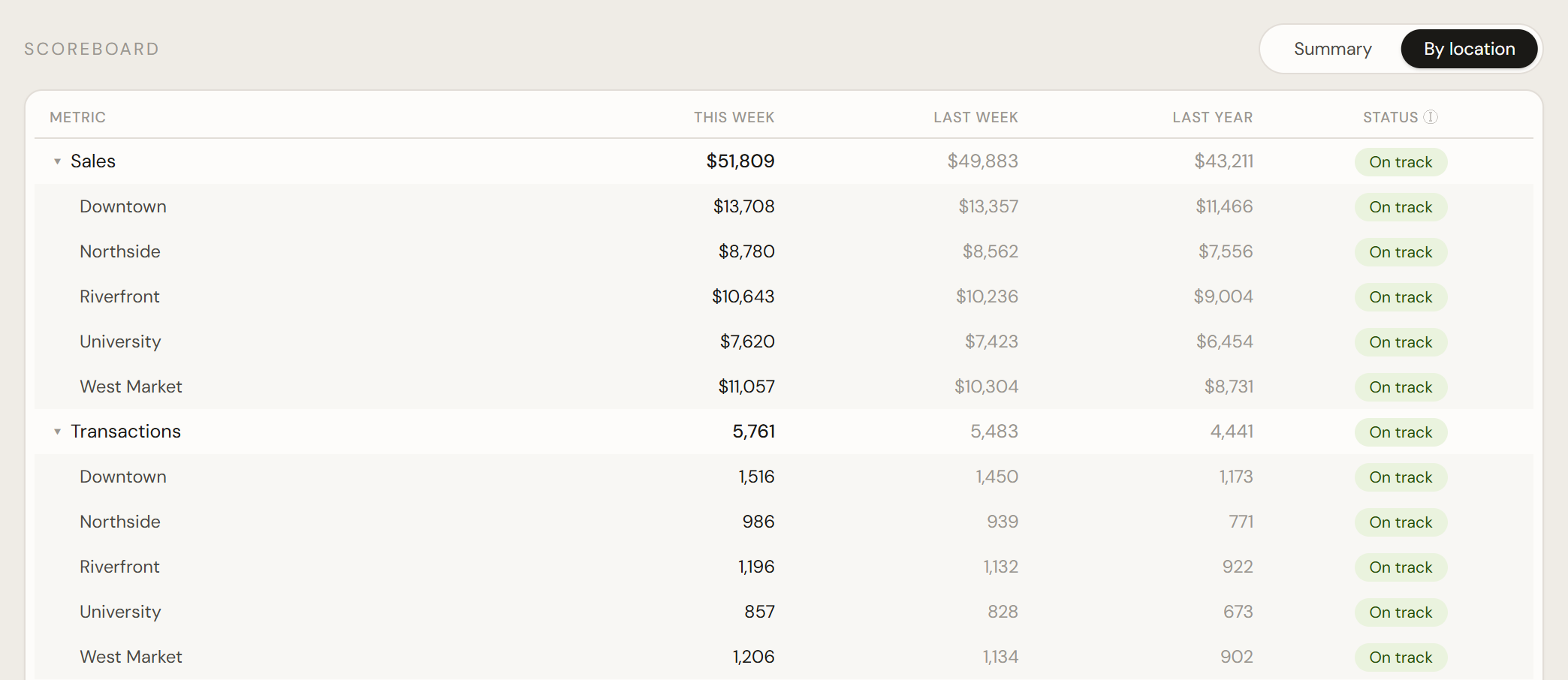
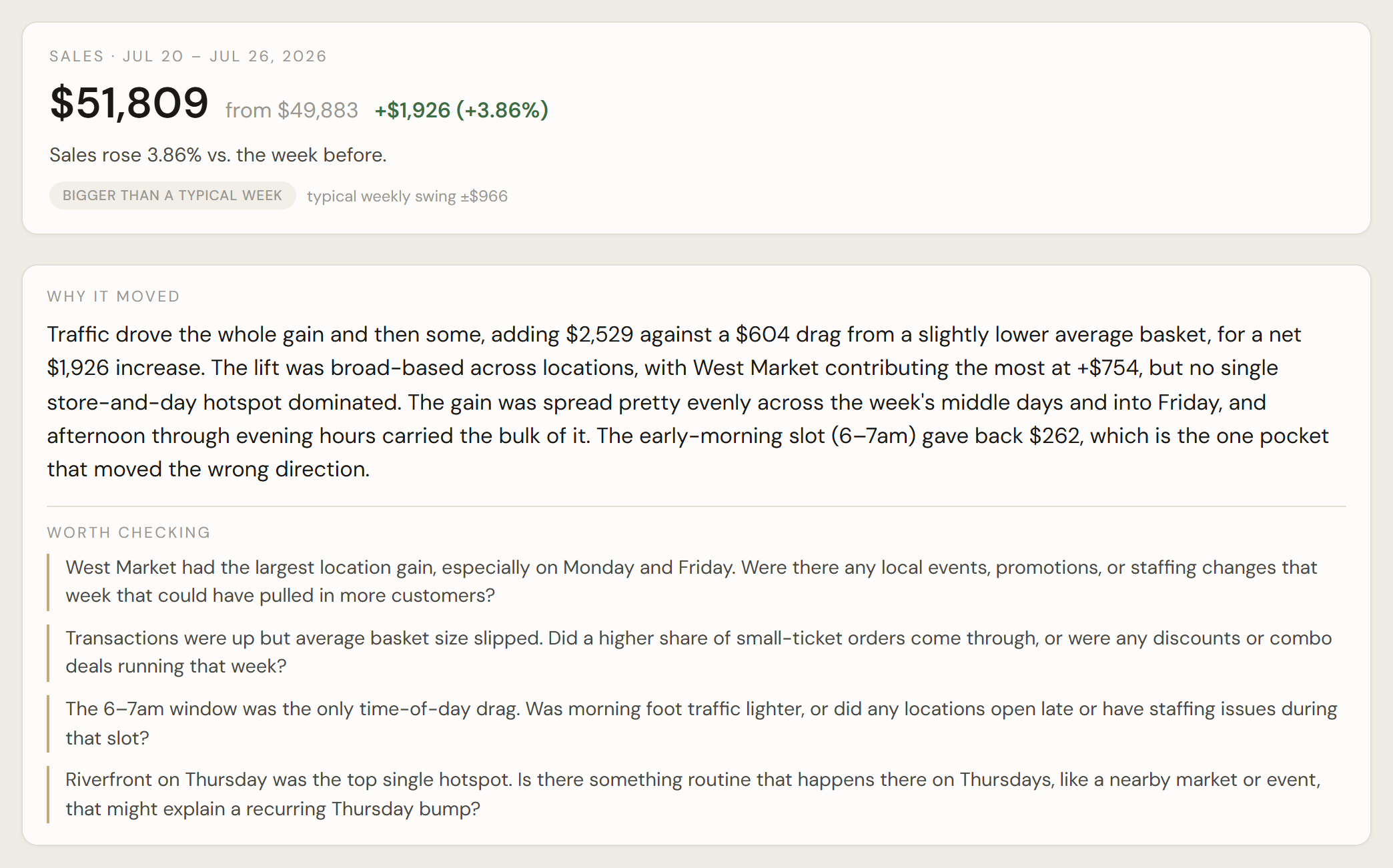
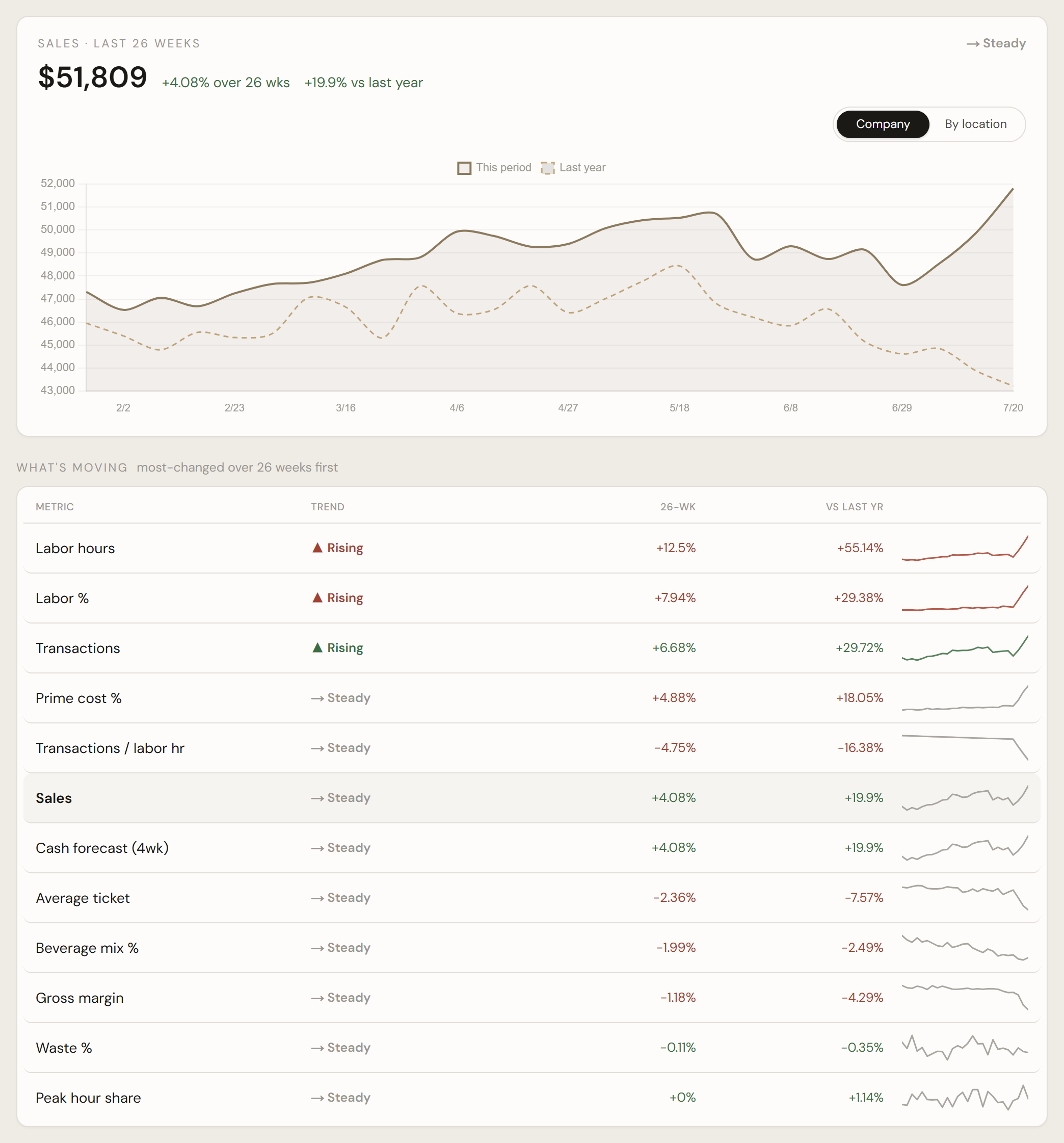
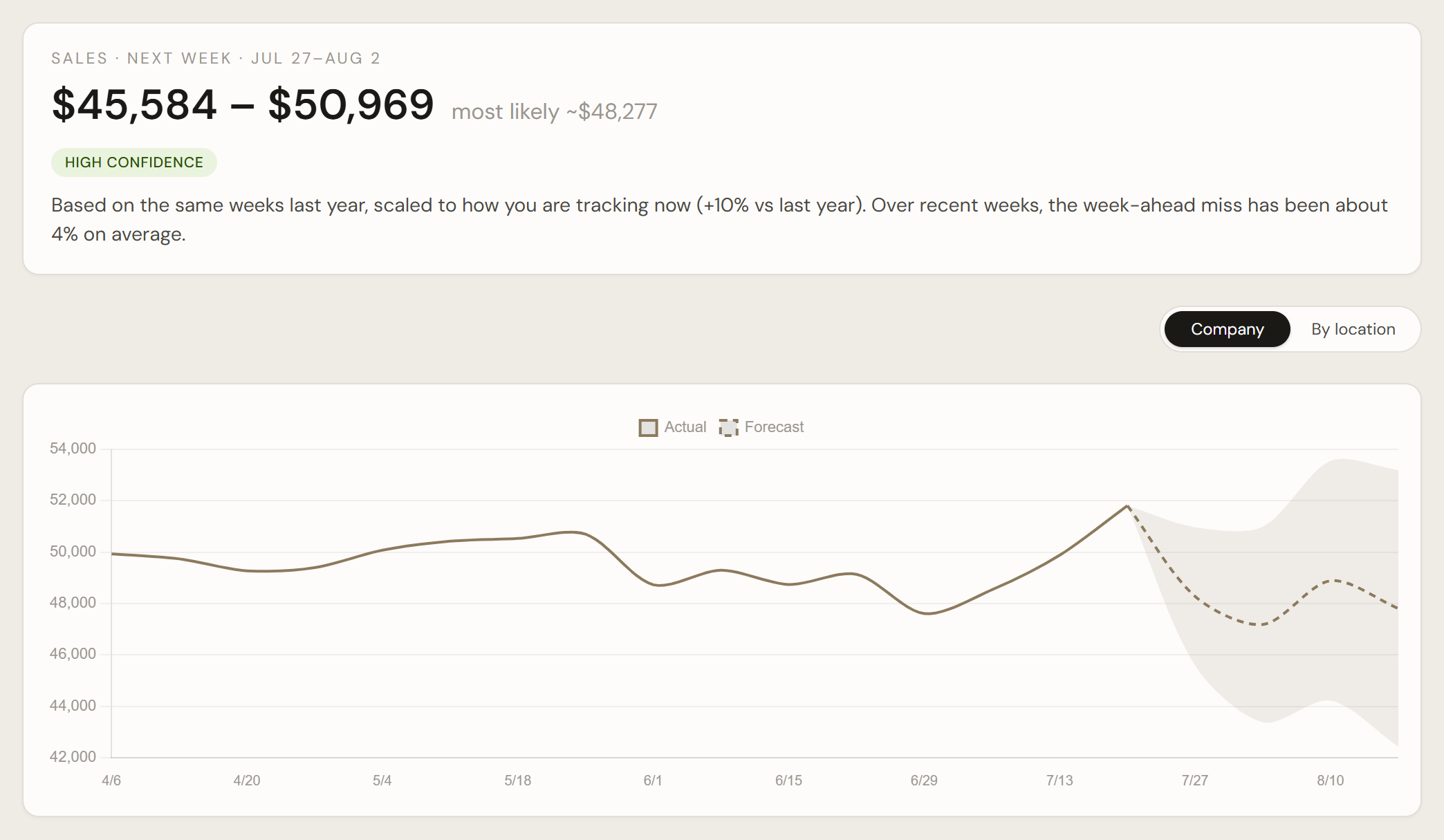
When a number raises a question, the answer is one click away. You get a calm, clear view of your business by location, channel, and week. See what drove a change, tell a trend from a blip, track against your targets, and model a fix before you make it.
What’s working, what to focus on, and the proof beneath it.
You confirm the real reason. Next week’s read remembers.
Shown with sample data. Your portal reflects your business, your metrics, and your language, configured during onboarding.
The difference between intelligence that feels generic and intelligence that feels specific is what happens before the first brief is delivered. Onboarding is where the foundation gets built, and that foundation is what makes everything that follows trustworthy.
A focused conversation about how your organization operates, which metrics actually matter, what your goals are, and what good looks like week over week. This is the highest-leverage hour in the entire engagement.
Every metric gets a precise, agreed-upon definition: what counts, what doesn’t, and how each one maps to your operations. This single source of truth is what makes the intelligence accurate rather than approximate.
Your data sources are connected, normalized, and validated. The dashboard is built around your specific KPIs. Clean data is not a technical concern. It is the prerequisite for a brief you can trust.
Your portal goes live and your first brief lands Monday morning. From there it’s a rhythm: the brief every Monday, the portal whenever a question comes up.
Performance Pulse is not for every business. It is for owners and leaders who are already running something real, and who are ready to stop making decisions with an incomplete picture.
If your data lives in three different systems, your Monday meeting starts with questions instead of answers, and you’ve wondered more than once whether you’re missing something, this was built for you.
Built for operators with more moving parts than any one person can hold in their head: multiple locations, multiple channels, data spread across systems. The industry matters less than the shape of the problem.
The honest comparison isn’t software. It’s the analyst you’ve thought about hiring. A capable one runs $110,000-plus a year, takes months to ramp, and can leave. Performance Pulse is a fraction of that, live in two weeks, and it doesn’t quit.
Performance Pulse starts at $2,000/month.
Pricing varies with your size, locations, and connected systems.
Start with a conversationNo pitch, no pressure. Just a direct conversation about what you’re running, what you need, and whether Performance Pulse is the right fit.